Dear Jagjeet, In today's edition, we highlight: - How the War in the Middle East Is Affecting Energy, Trade, and Finance
- China's New Chapter
- Survey: Asia-Pacific Perspectives
- Stablecoins and the Future of Payments
- A Perilous Fiscal Path
- 2026 Spring Meetings
|
Dear Jagjeet, In today's edition, we highlight: - How the War in the Middle East Is Affecting Energy, Trade, and Finance
- China's New Chapter
- Survey: Asia-Pacific Perspectives
- Stablecoins and the Future of Payments
- A Perilous Fiscal Path
- 2026 Spring Meetings
|
|
|
How the War in the Middle East Is Affecting Energy, Trade, and Finance |
How the War in the Middle East Is Affecting Energy, Trade, and Finance |
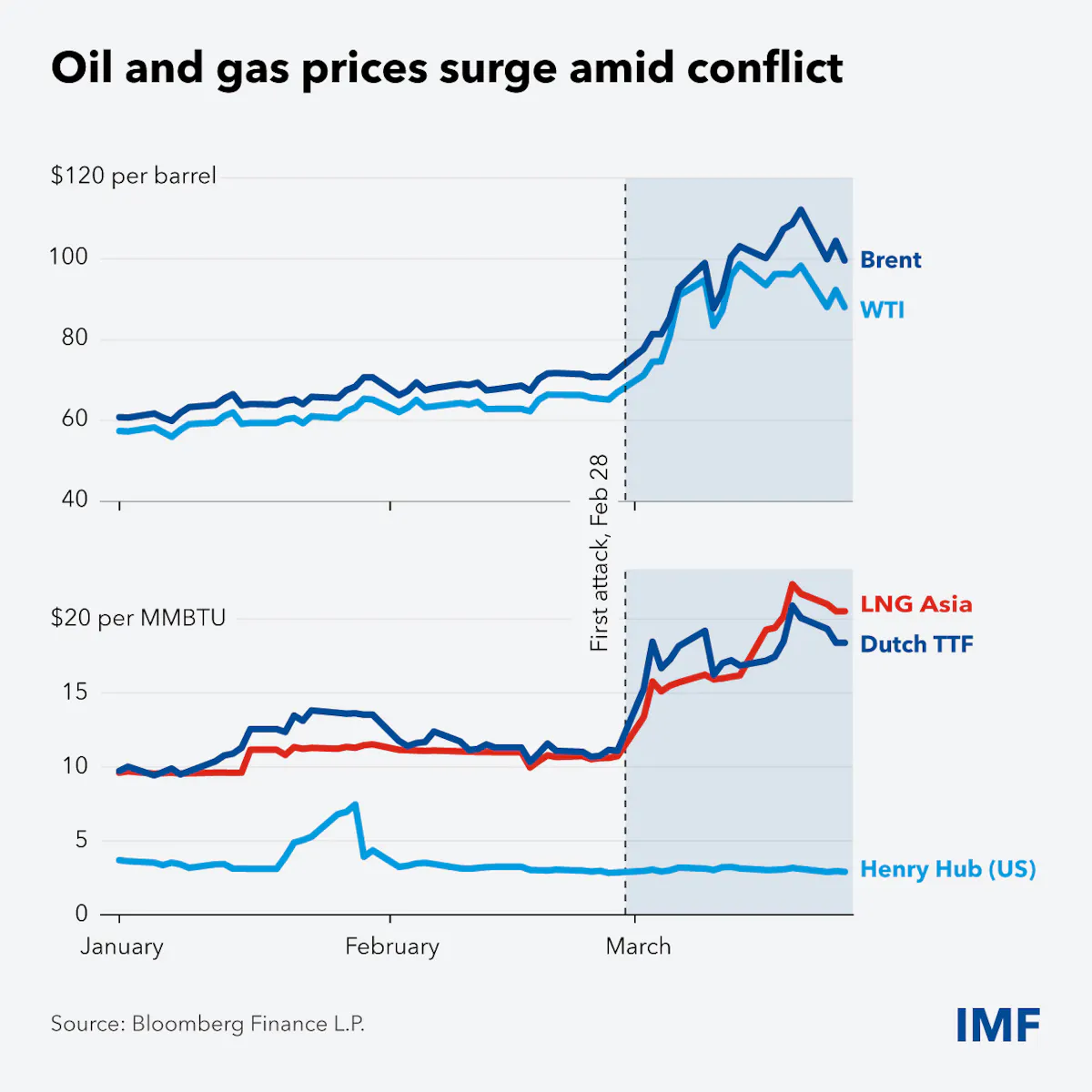 |
The war in the Middle East is upending lives and livelihoods in the region—and its economic impacts are being felt far beyond. Writing in a joint blog, IMF department directors note that "the shock is global, yet asymmetric. Energy importers are more exposed than exporters, poorer countries more than richer ones, and those with meager buffers more than those with ample reserves." The war has caused serious disruption to the economies of the most directly affected countries, including damage to their infrastructure and industries that could become long-lasting. Although these countries are resilient, their short-term growth prospects will be negatively affected. Meanwhile, large energy importers in Asia and Europe are bearing the brunt of higher fuel and input costs: about 25 to 30 percent of global oil and 20 percent of liquefied natural gas pass through the Strait of Hormuz, feeding demand not only in Asia but also in parts of Europe. Parts of the Middle East, Africa, Asia-Pacific, and Latin America face the added strain of higher food and fertilizer prices and tighter financial conditions. Low-income countries are especially at risk of food insecurity. Although the war could shape the global economy in different ways, all roads lead to higher prices and slower growth. A short conflict might send oil and gas prices soaring before markets adjust, while a long one could keep energy expensive and strain countries that rely on imports. At this pivotal moment, the IMF is stepping up as well. We are supporting our members—especially the most vulnerable—with policy advice, capacity development and, where needed and in coordination with the international community, financial assistance. As Managing Director Kristalina Georgieva has said: "In an uncertain world, more countries are needing more of our support. We are there for them." |
The war in the Middle East is upending lives and livelihoods in the region—and its economic impacts are being felt far beyond. Writing in a joint blog, IMF department directors note that "the shock is global, yet asymmetric. Energy importers are more exposed than exporters, poorer countries more than richer ones, and those with meager buffers more than those with ample reserves." The war has caused serious disruption to the economies of the most directly affected countries, including damage to their infrastructure and industries that could become long-lasting. Although these countries are resilient, their short-term growth prospects will be negatively affected. Meanwhile, large energy importers in Asia and Europe are bearing the brunt of higher fuel and input costs: about 25 to 30 percent of global oil and 20 percent of liquefied natural gas pass through the Strait of Hormuz, feeding demand not only in Asia but also in parts of Europe. Parts of the Middle East, Africa, Asia-Pacific, and Latin America face the added strain of higher food and fertilizer prices and tighter financial conditions. Low-income countries are especially at risk of food insecurity. Although the war could shape the global economy in different ways, all roads lead to higher prices and slower growth. A short conflict might send oil and gas prices soaring before markets adjust, while a long one could keep energy expensive and strain countries that rely on imports. At this pivotal moment, the IMF is stepping up as well. We are supporting our members—especially the most vulnerable—with policy advice, capacity development and, where needed and in coordination with the international community, financial assistance. As Managing Director Kristalina Georgieva has said: "In an uncertain world, more countries are needing more of our support. We are there for them." |
China's New Chapter: Rebalancing and Unleashing Market Forces |
China's New Chapter: Rebalancing and Unleashing Market Forces |
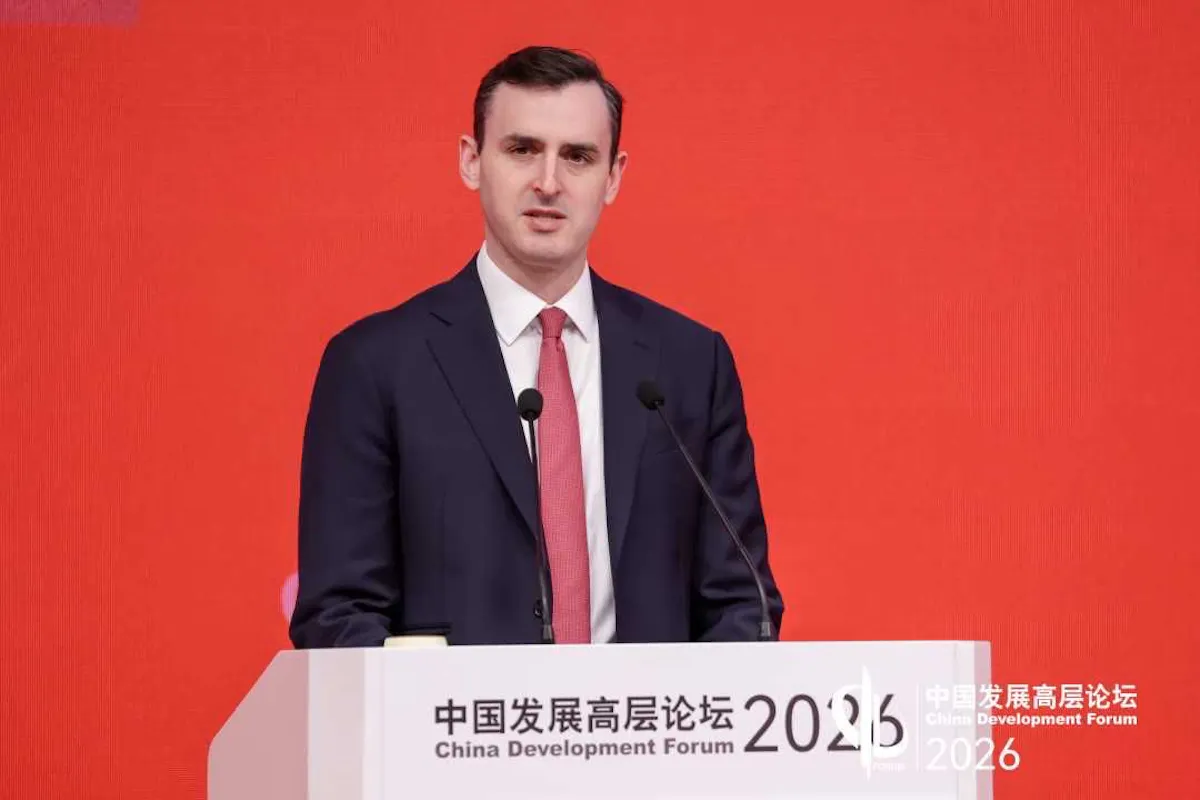 |
"Market forces are the key to unlocking the next phase of China's economic growth," said IMF First Deputy Managing Director Dan Katz, speaking at the China Development Forum. He emphasized that the state's role will need to evolve. "Rather than directing investment toward specific industries, government should instead build the conditions that enable private sector innovation and market forces to direct China's immense resources to where they can generate the most value." Katz highlighted three market-oriented reforms. First, leveling the playing field. IMF estimates suggest that scaling back preferential treatment provided to specific firms and sectors could boost aggregate productivity by over 1 percent, in turn raising China's level of GDP by up to 2 percent. Second, greater reliance on market-based pricing. Reforms that channel a larger share of funding toward more productive firms—and reduce incentives for overproduction—would allow China to make better use of its high savings. Third, strengthening the services sector, particularly healthcare, education, and technology, would help support more durable and balanced growth. "With China already accounting for approximately 30 percent of global manufacturing output, the service sector has much more room to grow," he noted. |
"Market forces are the key to unlocking the next phase of China's economic growth," said IMF First Deputy Managing Director Dan Katz, speaking at the China Development Forum. He emphasized that the state's role will need to evolve. "Rather than directing investment toward specific industries, government should instead build the conditions that enable private sector innovation and market forces to direct China's immense resources to where they can generate the most value." Katz highlighted three market-oriented reforms. First, leveling the playing field. IMF estimates suggest that scaling back preferential treatment provided to specific firms and sectors could boost aggregate productivity by over 1 percent, in turn raising China's level of GDP by up to 2 percent. Second, greater reliance on market-based pricing. Reforms that channel a larger share of funding toward more productive firms—and reduce incentives for overproduction—would allow China to make better use of its high savings. Third, strengthening the services sector, particularly healthcare, education, and technology, would help support more durable and balanced growth. "With China already accounting for approximately 30 percent of global manufacturing output, the service sector has much more room to grow," he noted. |
Asia-Pacific Perspectives: Survey on the IMF's Work |
Asia-Pacific Perspectives: Survey on the IMF's Work |
Do you live in the Asia Pacific region? If so, do you have a few minutes to share your views on the IMF's work and communications in your country or in the region? Take our short survey by clicking the link below. Your feedback will help us improve our engagement ahead of the 2026 Annual Meetings in Thailand. After completing the survey, you will have the option to sign up for a free subscription to the IMF's Finance & Development (F&D) magazine. |
Do you live in the Asia Pacific region? If so, do you have a few minutes to share your views on the IMF's work and communications in your country or in the region? Take our short survey by clicking the link below. Your feedback will help us improve our engagement ahead of the 2026 Annual Meetings in Thailand. After completing the survey, you will have the option to sign up for a free subscription to the IMF's Finance & Development (F&D) magazine. |
Stablecoins and the Future of Payments: Evidence from Financial Markets |
Stablecoins and the Future of Payments: Evidence from Financial Markets |
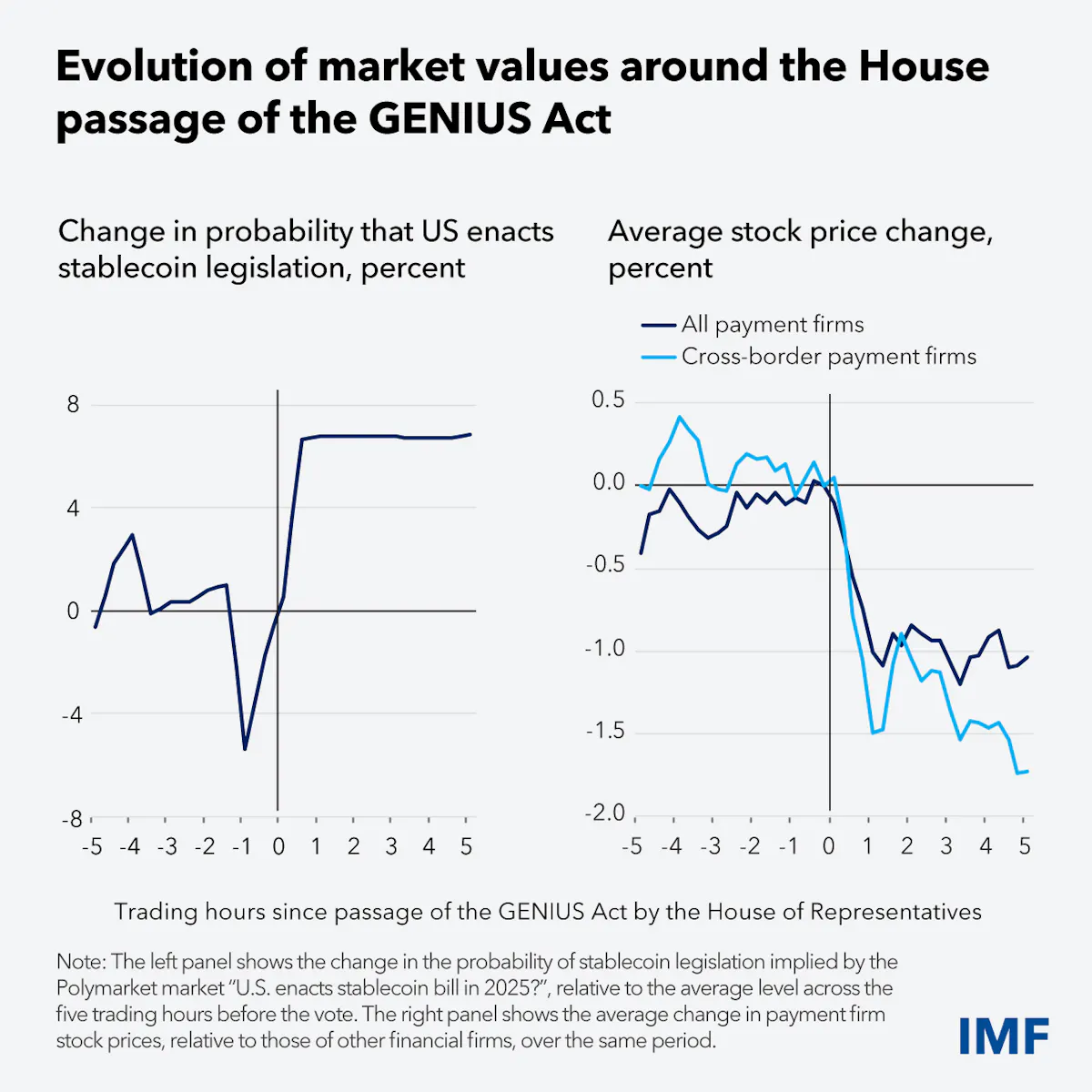 |
New IMF research suggests that stablecoins have the potential to become an important force in payments. By analyzing the stock market impact of the GENIUS Act, which provided regulatory clarity and boosted trust in stablecoins, IMF staff found evidence that incumbent U.S. payment firms face significant competitive pressure. Once the bill was passed, incumbent payment firms' stocks fell by 1 percent. However, when accounting for market anticipation using data from prediction markets, the total impact was more significant - an 18 percent decline, or roughly $300 billion in market value. This response was larger for cross-border payment providers, while firms with strong network effects or existing crypto integrations proved more resilient. This estimate exceeds the impact of previous regulatory shocks, such as the Durbin Amendment and the European Central Bank's plan to issue a digital euro, suggesting that stablecoins will play a significant role in the future of global payments. |
New IMF research suggests that stablecoins have the potential to become an important force in payments. By analyzing the stock market impact of the GENIUS Act, which provided regulatory clarity and boosted trust in stablecoins, IMF staff found evidence that incumbent U.S. payment firms face significant competitive pressure. Once the bill was passed, incumbent payment firms' stocks fell by 1 percent. However, when accounting for market anticipation using data from prediction markets, the total impact was more significant - an 18 percent decline, or roughly $300 billion in market value. This response was larger for cross-border payment providers, while firms with strong network effects or existing crypto integrations proved more resilient. This estimate exceeds the impact of previous regulatory shocks, such as the Durbin Amendment and the European Central Bank's plan to issue a digital euro, suggesting that stablecoins will play a significant role in the future of global payments. |
The United States is in a precarious fiscal position, with a debt-to-GDP ratio poised to breach its historic post–World War II high, Alan Auerbach writes in F&D. But unlike in 1946, there is no large peace dividend from reduced defense spending to rescue public finances, he adds. Demographic factors are pushing spending even higher through the continuing expansion of old-age entitlements, and there seems little prospect of avoiding large deficits and higher debt, even if economic conditions remain favorable. "For the immediate future…it's hard to bet against a long, steady worsening of fiscal problems without a realignment and restoration of the possibility of bipartisan action." |
The United States is in a precarious fiscal position, with a debt-to-GDP ratio poised to breach its historic post–World War II high, Alan Auerbach writes in F&D. But unlike in 1946, there is no large peace dividend from reduced defense spending to rescue public finances, he adds. Demographic factors are pushing spending even higher through the continuing expansion of old-age entitlements, and there seems little prospect of avoiding large deficits and higher debt, even if economic conditions remain favorable. "For the immediate future…it's hard to bet against a long, steady worsening of fiscal problems without a realignment and restoration of the possibility of bipartisan action." |
|
|
APRIL 13-18, 2026 2026 Spring Meetings The 2026 Spring Meetings will take place in person from Monday, April 13, through Saturday, April 18 in the IMF and World Bank Group headquarters, in Washington, D.C. The Meetings bring together central bankers, ministers of finance and development, private sector executives, civil society representatives, and academics to discuss the state of the global economy and issues of international concern. They are the only gathering of its kind in the world and a unique forum for discussion on economic policymaking. Registration is now open. |
APRIL 13-18, 2026 2026 Spring Meetings The 2026 Spring Meetings will take place in person from Monday, April 13, through Saturday, April 18 in the IMF and World Bank Group headquarters, in Washington, D.C. The Meetings bring together central bankers, ministers of finance and development, private sector executives, civil society representatives, and academics to discuss the state of the global economy and issues of international concern. They are the only gathering of its kind in the world and a unique forum for discussion on economic policymaking. Registration is now open. |
|
|
Thank you very much for your interest in the Weekend Read! Be sure to let us know what issues and trends we should have on our radar. |
Thank you very much for your interest in the Weekend Read! Be sure to let us know what issues and trends we should have on our radar. |
|
|
| | Editor | IMF Weekend Read |
Editor | IMF Weekend Read |
| |
|
This email was sent to gjagjeet610.worldwin@blogger.com on behalf of: International Monetary Fund 1900 Pennsylvania Ave NW · Washington, DC · 20431 |
This email was sent to gjagjeet610.worldwin@blogger.com on behalf of: International Monetary Fund 1900 Pennsylvania Ave NW · Washington, DC · 20431 |
|
|
| |